





26 May 2010
Untitled by Eeva-Mari Haikala
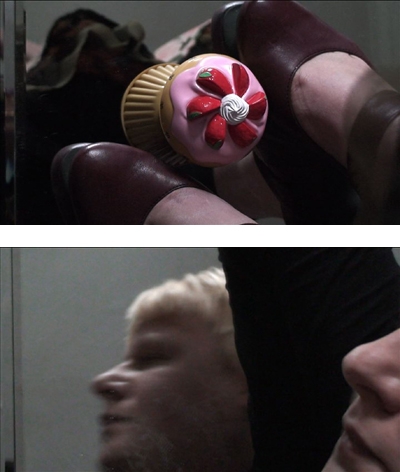

When the performance starts, on the wall of the gallery space (where the audience is also located) a picture is projected - a fake cup cake (actually a kitchen clock). The fake tart, the other props and myself are in a storage room behind the audience. The performance is done to a camera that is broadcasting live via a projector to the gallery space. The camera is shooting a mirror that is lying on the floor.
I step on the mirror and start to read:
“Hi, my name is Eeva-Mari and I would like to start by reading an excerpt from a text written by Julia Donner to you. The whole text is about a finnish (female) painter Helene Shjerfbeck (1862-1946) and can be found on the YLE (finnish broadcasting company) webpage. The translation is by me.“Narrow circle of life and sparse subjects – mainly portraits and still lifes – doesn´t mean Helene Shjerfbeck’s art is plain. On the contrary, restrictions meant freedom of creation and surprising limitlessness.
At the end of the 19th century artists were seen as servants of their own country, Finland. Painters such as Albert Edelfelt and Eero Järnefelt (who are men, my own comment) felt their mission was to paint national subjects in a way that would promote the Finnish nation amongst other nations. In Helen Shjerfbeck’s art it is impossible to find these kind of intentions. She is foremost a painter.”
Albert Edelfelt who was mentioned above has been and still is the hero of Finnish Art History. One of his most notorious painting is a portrait of the French chemist Louis Pasteur. Edelfelt, like many artists on that time, lived and worked in Paris too, where he also painted Pasteur’s portrait. Helene Shjerfbeck was younger than Edelfelt, and she painted in Paris too. It is an historical fact that Shjerfbeck worked as an assistant for Edelfelt when he was working on the portrait of Louis Pasteur. No one actually knows how much Shjerfbeck contributed to this painting. We do know that in one of Edelfelt’s letter he describes the painting process: “Miss Shjerfbeck is standing here to paint. This is a real collaboration, because I have both drawn and painted the most difficult parts like head and hands.” – and art historians nowadays say that Shjerfbeck’s contiribution to the portrait was significant. It is easy to agree with that. There is much more to a full figure portrait than just the head and hands.
No one knows what the already established and older painter Edelfelt paid the young Helene for her work. Some of Shjerfbeck's own letters tell us that she was well paid – but in one of her letters to her friend, also a female painter, she says that all she got from Edelfelt was a box of chocolates.
This performance is a homage to young Helene Shjerfbeck and to her painting ‘Two Female Profiles’, painted in 1881. To get started I just need to switch on my tart.”
I switch on the fake cake / kitchen clock. Whilst it is clicking, I go and lie on the mirror so that my face creates a double silhoutte portait . I lie there until the alarm goes off. I write on the mirror with lipstick “e-m 10”. The performance is over.
 Subscribe to RSS